Punta Tombo

Field updates: Argentina, October-November 2025

Written by Dr. Eric Wagner Starting the season – stake survey and tag hunting In late October, Dr. Eric Wagner and Abrahms graduate student Meredith Honig traveled to Argentina to start the 2025-2026 field season. After getting a provisional permit from the provincial authorities, they arrived at Punta Tombo on October 29. They then spent the next two days completing […]

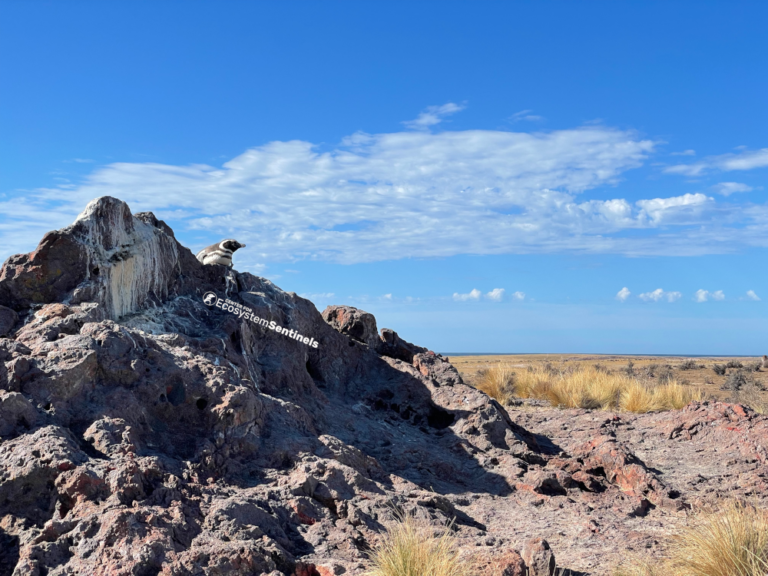
A penguin stands on a large rock with a blue sky as a backdrop.

Field updates: Argentina, March 2025

Written by Dr. Eric Wagner Thanks once again to generous support from Zoo Augsburg, research scientist Dr. Eric Wagner and computer specialist Pearl Wellington traveled to Punta Tombo in early March for a couple of weeks to mark the end of the breeding season. Eric and Pearl went to deploy twenty geolocating time-depth recorder (GLD) tags to female and male

Field update: Argentina, December 2024 – January 2025

This field season is the first time we’ve been at Punta Tombo, Argentina persistently from October to March since before the pandemic! We’ve seen chicks hatch and watched them grow into chubby fledglings. Unfortunately many died in December with their bellies full; we suspect it was due to toxic algae, which could also be the cause of the 71 southern

Field updates: Argentina, April 2024

Thanks to the generous support of Zoo Augsburg in Germany, Dr. Eric Wagner and Katie Holt were able to return to Punta Tombo for a couple of weeks in April. There, they put twenty satellite tags on penguins—ten females and ten males—that were about to start their post-breeding migration. As of today 18 satellite tags are still transmitting to our

Field Updates: Tombo Jan-Feb 2024

We continued our Punta Tombo field season this winter with graduate student Erik Johansson, former undergrad lab member Chloe Rabinowitz, and program coordinator Kalyna Durbak staying on site from January 12 through February 21. Our goal for this trip was to attach GTA* and GPS tags on adult penguins who were actively feeding chicks in order to log their foraging

Field updates: Argentina, April 2023

Thanks to the generous support of Zoo Augsburg in Germany, Dr. Ginger Rebstock and Dr. Eric Wagner were able to return to Punta Tombo for a couple of weeks in April. There, they put twenty satellite tags on penguins—ten females and ten males—that were about to start their post-breeding migration. From last year’s tagging effort, we know that females hug

Field updates: Argentina, Winter 2023

In January and February of 2023 Dr. Dee Boersma, along with PhD students Katie Holt (Boersma Lab) and Erik Johansson (Abrahms Lab), spent six weeks in Punta Tombo to set up the remote scales that weigh penguins on their way in and out of the breeding area, and followed 19 penguins using GPS tags. The three of them were also able

A penguin stands on a large rock with a blue sky as a backdrop.

Changes in habitat use and nesting density in a declining seabird colony

From the Abstract: “Seabirds in expanding colonies select the highest-quality nesting habitat, but habitat selection has seldom been studied in declining colonies. We studied a colony of Magellanic penguins (Spheniscus magellanicus) that declined from 314,000 active nests in 1987 to 201,000 in 2014. As expected, nest quality and reproductive success were higher in burrow habitats than in other habitats, and

A wet Magellanic chick stands in a flooded burrow.

Climate change and reproductive failure

Full Title: Climate change increases reproductive failure in Magellanic penguins Scientists studied nearly 3,500 Magellanic penguin chicks over 27 years to see how weather affected their survival. Starvation was the most common cause of death overall, but in two years heavy rain killed nearly half of all chicks. Predation and starvation happened every year, while storms caused deaths in about

Scroll to Top