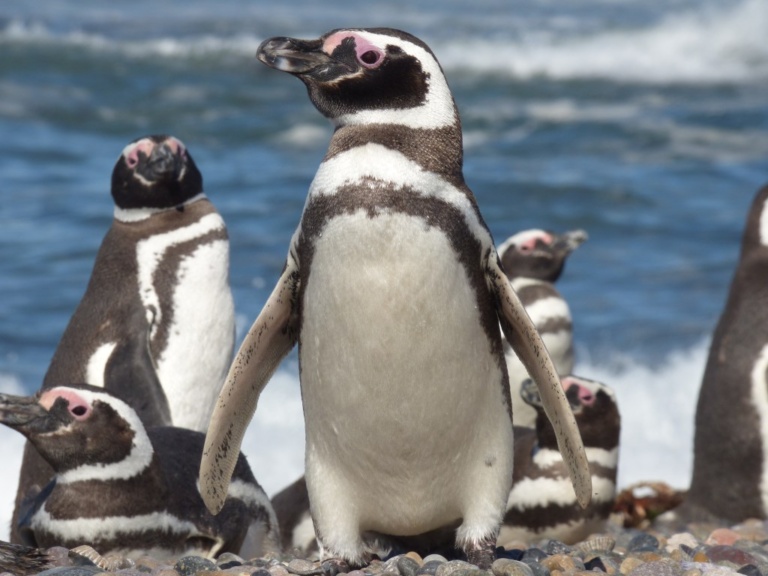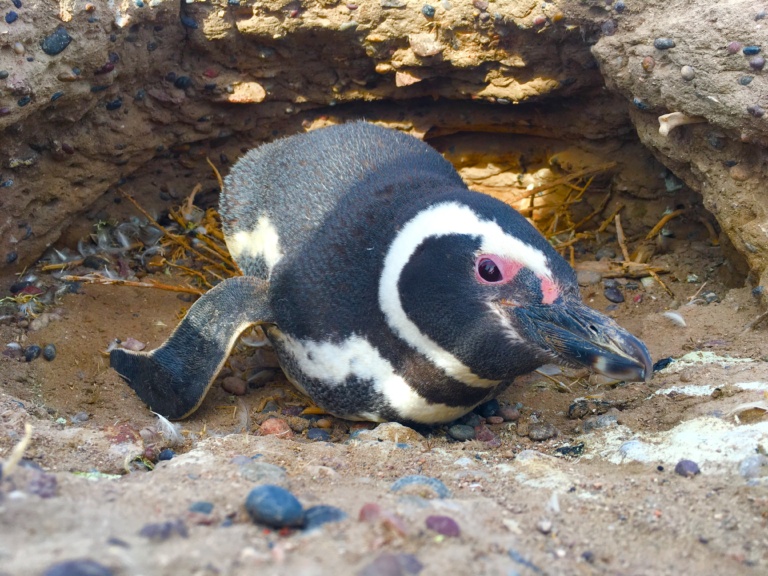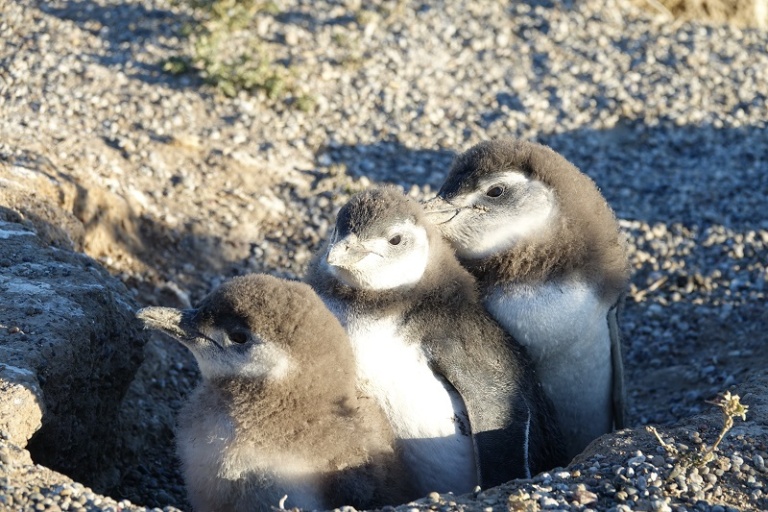
Magellanic penguins

Boersma Lab, Updates from the Field

Field Updates: Tombo Jan-Feb 2024

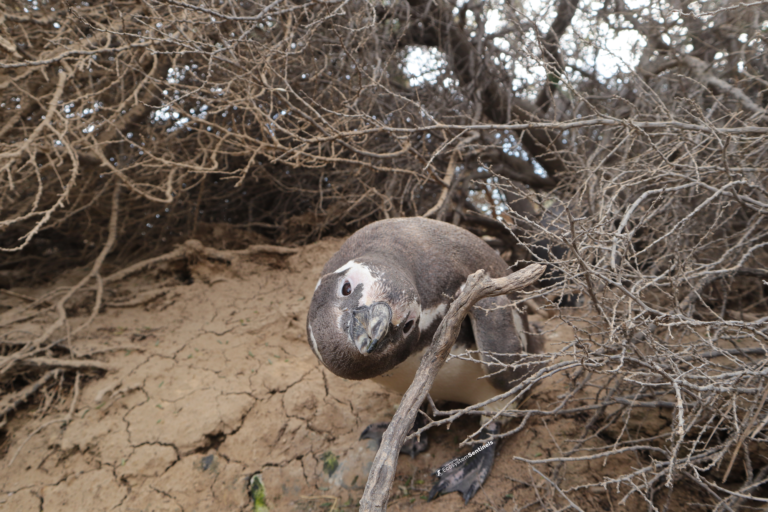
We continued our Punta Tombo field season this winter with graduate student Erik Johansson, former undergrad lab member Chloe Rabinowitz, and program coordinator Kalyna Durbak staying on site from January 12 through February 21. Our goal for this trip was to attach GTA* and GPS tags on adult penguins who were actively feeding chicks in order to log their foraging […]

, , , ,
Publications

A fearful scourge to the penguin colonies

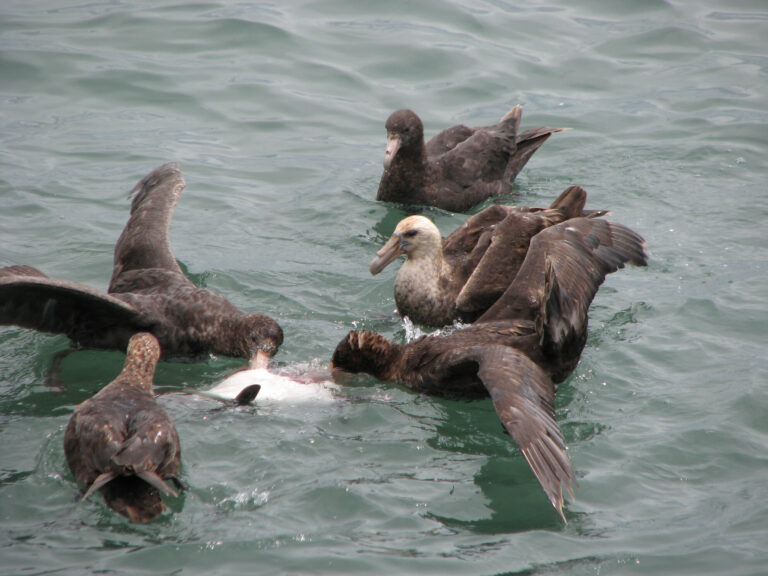
Full title: A fearful scourge to the penguin colonies: Southern giant petrel (Macronectes giganteus) predation on living Magellanic penguins (Spheniscus magellanicus) may be more common than assumedAuthors: Dr. Eric Wagner, Dr. Ginger Rebstock and Dr. P Dee BoersmaJournal: Marine Ecology Press SeriesDOI: 10.1002/ece3.11258 Excerpt from abstract: Southern giant petrels (Macronectes giganteus) are important consumers that range across the oceans throughout

, , , ,
Publications

Sex-specific migratory behavior in a marine predator results in higher risks to females

Protecting migratory animals is challenging because males and females can travel to different places at different times of the year. In this study, Dr. Ginger Rebstock and Dr. Dee Boersma tracked male and female Magellanic penguins during their migration and found that females stayed closer to shore and slightly farther north than males. Both sexes reached similar overall latitudes, but

, , , ,
Boersma Lab, Updates from the Field

Field updates: Argentina, September 2023

Written by Dr. Dee Boersma The ongoing pinniped (seals and walruses) die-off on Peninsula Valdés is catastrophic. Our contacts in Argentina–two local veterinarians (Marci Uhart and Ralph Vanstreels), and Claudia Campagna of WCS–tell us that hundreds and potentially thousands of sea lions and elephant seals have died. Avian flu (more widely known as bird flu) has devastated seabird populations throughout

, , ,
Publications

Changing course: Relocating commercial tanker lanes significantly reduces threat of chronic oiling for a top marine predator

Authors: Eric L. Wagner, Esteban Frere, P. Dee BoersmaJournal: Marine Pollution BulletinDOI: 10.1016/j.marpolbul.2023.11 Photo credit: National Ocean Service Image Gallery Summary Written by Sofia Denkovski Argentinian oil and effects on seabirds Surveys from 1982-1990 suggested more than 40,000 penguins died per year in Chubut and Santa Cruz from chronic oiling. This was hypothesized to be due to the colonies’ proximity

, ,
Boersma Lab, Updates from the Field

Field updates: Argentina, April 2023

Thanks to the generous support of Zoo Augsburg in Germany, Dr. Ginger Rebstock and Dr. Eric Wagner were able to return to Punta Tombo for a couple of weeks in April. There, they put twenty satellite tags on penguins—ten females and ten males—that were about to start their post-breeding migration. From last year’s tagging effort, we know that females hug

, , ,
Abrahms Lab, Boersma Lab, Updates from the Field

Field updates: Argentina, Winter 2023

In January and February of 2023 Dr. Dee Boersma, along with PhD students Katie Holt (Boersma Lab) and Erik Johansson (Abrahms Lab), spent six weeks in Punta Tombo to set up the remote scales that weigh penguins on their way in and out of the breeding area, and followed 19 penguins using GPS tags. The three of them were also able

, , , ,
Publications

Climate presses and pulses mediate the decline of a migratory predator

Long-term climate trends and short-term extreme events can affect animals in different ways, but scientists do not always know how these effects work together. This study used a “press–pulse” framework to separate the impacts of ongoing climate change from sudden extreme events on Magellanic penguins. Researchers analyzed 38 years of data from 53,959 penguins and found that long-term changes and

, , , ,
Publications

Should I stay or should I go: factors influencing mate retention and divorce in a colonial seabird

Authors: Eric L. Wagner, Caroline D. Cappello, P. Dee BoersmaJournal: Animal BehaviourDOI: 10.1016/j.anbehav.2022.08.002 Divorce among serially monogamous birds can lead to increased reproductive success if an individual obtains a higher-quality mate or nest site, or it can lead to lower reproductive success due to lack of pair experience or reduced breeding opportunities…

, , ,
Publications

Unprecedented heat mortality of Magellanic Penguins

Authors: Katie Holt and Dee BoersmaJournal: Ornithological ApplicationsDOI: https://doi.org/10.1093/ornithapp/duab052 Abstract excerpt: Extreme weather events are becoming more frequent and severe, leading to an increase in direct, adverse thermoregulatory impacts on wildlife. Here, we document an unprecedented, single-day, heat-related mortality event of Magellanic Penguins (Spheniscus magellanicus) at Punta Tombo, Chubut Province, Argentina, one of the largest breeding colonies for this species.

, ,
Publications

Consequences of phenological shifts and a compressed breeding period in Magellanic penguins

Excerpt from the abstract: “Using 34 yr of data from the Magellanic penguin (Spheniscus magellanicus) colony at Punta Tombo, Argentina, we examined the consequences of the delayed onset of breeding (i.e., arrival and egg-laying dates) that has occurred at the colony since 1983. […] We find that delayed breeding has significantly compressed nestling periods at Punta Tombo, influencing chick growth and

, ,
Publications

Effects of age on Magellanic penguin telomeres

Full Title: Magellanic penguin telomeres do not shorten with age with increased reproductive effort, investment, and basal corticosterone From the Abstract: “All species should invest in systems that enhance longevity; however, a fundamental adult life-history trade-off exists between the metabolic resources allocated to maintenance and those allocated to reproduction. Long-lived species will invest more in reproduction than in somatic maintenance

, ,
Scroll to Top