Dr. Caroline Cappello

Two people on a blow-up boat look at a Galapagos penguin that is standing on the edge of the boat.Boersma Lab, Updates from the Field

Field Updates: Galápagos, Summer 2025

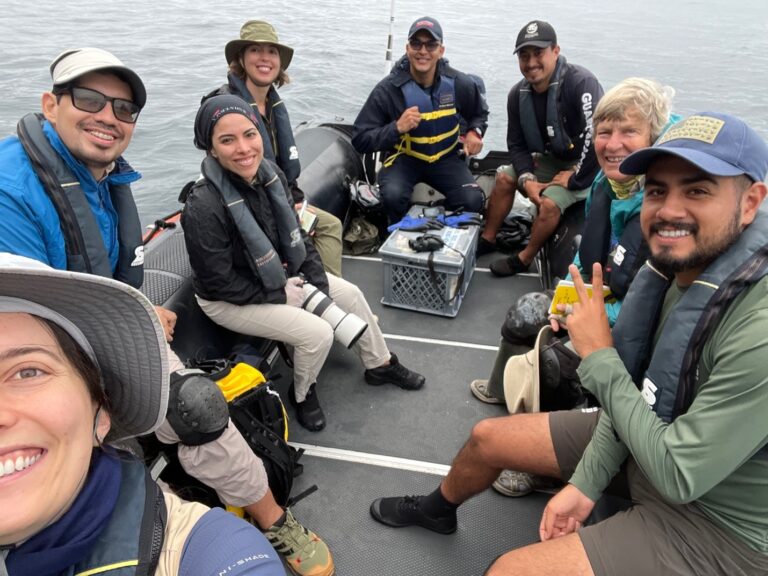
Dr. Dee Boersma, Dr. Sue Moore, and Dr. Caroline Cappello were in the Galápagos from July 25 – August 3 to survey the penguins on the islands. They were able to measure 36 of them—16 more than last year! Measuring penguins is an essential part of our project, which is maintaining continuity with our decades-long dataset on the species. Dr. Boersma began studying […]

, , , ,
Boersma Lab, News

Dr. Dee Boersma featured in latest National Geographic!

Make sure to pick up the latest copy of National Geographic and read about Dr. Dee Boersma‘s work on Galápagos penguins! Reporter Rene Ebersole traveled with Dee and recent grad Caroline Cappello last summer as they checked up on the human-built Galápagos penguin nests they built in 2010. Included in the article is a sweet photo of Dee and Caroline

, ,
Boersma Lab, Updates from the Field

Field Updates: Galápagos Islands, summer 2024

In July 2024, Dr. Dee Boersma and Dr. Caroline Cappello traveled to the Galápagos Islands for a penguin expedition unlike any they’d experienced before. Since 2010, CES has collaborated with Galápagos National Park and conservationist Godfrey Merlen to visit penguin breeding areas and conduct research. After Godfrey’s passing in 2023, CES—with heavy hearts but optimism for the future—sought a new

, , , ,
Publications

Should I stay or should I go: factors influencing mate retention and divorce in a colonial seabird

Authors: Eric L. Wagner, Caroline D. Cappello, P. Dee BoersmaJournal: Animal BehaviourDOI: 10.1016/j.anbehav.2022.08.002 Divorce among serially monogamous birds can lead to increased reproductive success if an individual obtains a higher-quality mate or nest site, or it can lead to lower reproductive success due to lack of pair experience or reduced breeding opportunities…

, , ,
Publications

Consequences of phenological shifts and a compressed breeding period in Magellanic penguins

Excerpt from the abstract: “Using 34 yr of data from the Magellanic penguin (Spheniscus magellanicus) colony at Punta Tombo, Argentina, we examined the consequences of the delayed onset of breeding (i.e., arrival and egg-laying dates) that has occurred at the colony since 1983. […] We find that delayed breeding has significantly compressed nestling periods at Punta Tombo, influencing chick growth and

, ,
Publications

Sexing Galápagos penguins by morphological measurements

Identifying the sex of animals is important for conservation and behavior studies, but it can be difficult in species where males and females look similar. In this study, scientists tested simple body measurements to determine the sex of Galápagos penguins without harming them. By measuring features like bill depth and length, they correctly identified the sex of 95% of the

, ,
Gal_adult_juvenile_feed_wmPublications

First Observations of Post-Fledging Care in Galápagos Penguins

Until recently, species from all but three families of seabirds were known to give extended parental care, provisioning young after fledging. The exceptions were shearwaters, storm-petrels, and penguins. The Gentoo Penguin (Pygoscelis papua) is now known to feed its young after fledging. This paper adds the Galapagos Penguin (Spheniscus mendiculus) to the list, describing five instances of adult provisioning of

, ,
Scroll to Top