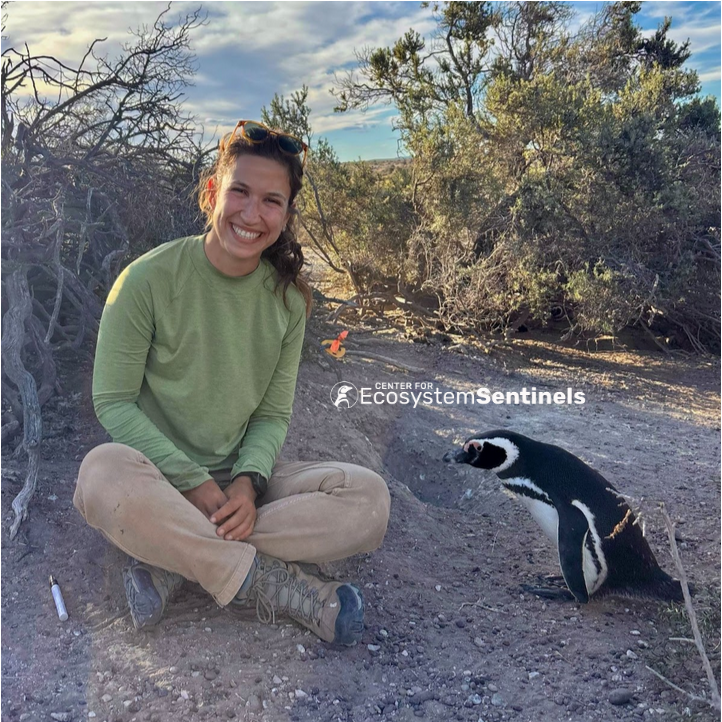
Next up in our Meet CES series is Kyra McClelland! Kyra is the newest graduate student in the Abrahms Lab. Read on to learn more about Kyra’s inspiration to become a marine biologist and a very memorable field work moment!

How are you liking Seattle and the UW campus?
I really love Seattle, and the UW campus is beautiful. I am surprised by how much I enjoy the overcast days! Of course, months of overcast without seeing the sun is difficult, but I find the way the sky glows when the clouds aren’t particularly dense to be so beautiful and calming, like staring at the sky from below waves.
What inspired you to pursue a PhD after receiving your MS in Biology?
I had always planned on pursuing a PhD. I was raised in a non-academic family, but when I shared that I wanted to be a marine biologist to my grandmother as a young child, largely influenced by the movie Free Willy, she informed me I’d need a PhD for that, and thus I have sought to gain a doctoral degree ever since! It’s a little silly, but it’s the truth. After finishing my BS in Marine Biology, I decided to take some time to explore different opportunities. Deciding to go back to school for my MS was my way of seeking confirmation that I did want to pursue research as a career. Despite some challenges, I’m very glad to have come to the UW for this purpose!
How do you stay organized? Do you have a digital setup, or do you keep a paper notebook?
I still haven’t found a totally fool-proof system of organization, and I tend to try different things out. As of now, a semi-organized chaos method of Google calendar events and deadlines, digital to do lists on my phone, a running to do list in a Google doc, and a physical notebook with thoughts and ideas seems to be working. While I love a physical notebook, the ability to easily search through digital notes has been crucial.

Describe a memorable field work moment.
One of the most memorable experiences was on the final day of trailing my field methods in Zimbabwe in 2022. We found a herd via radio telemetry, then by foot tracked the group into the bush. After taking some photos for individual ID from a short distance away, the elephants began moving in our general direction. We realized they would see us if we remained in the same spot, so we began a very slow retreat (elephants have relatively poor eyesight, but they are sensitive to movement).
One adult female stopped moving, and looked in our general direction. We froze in place, afraid to provoke the herd. She appeared to have seen us, but rather than showing any aggressive displays, she meandered over to a young elephant. It was a moment that could have been very scary depending on her reaction, and we were fortunate she didn’t see us as a threat, as some of the elephants in that region can be quite aggressive.
I read in your Abrahms Lab website bio that you enjoy sewing. Do you find inspiration for your sewing from your research?
Yes! I find inspiration primarily from nature, including my work. At the moment, my favorite ways to create are crocheting, sewing, and embroidery, typically using colors or patterns seen in nature, but I also enjoy painting, and these scenes are often directly pulled from field work experiences.